

If you’ve ever looked for couples therapy and noticed phrases like “EFT-informed,” “trained in EFT,” or “uses Emotionally Focused Therapy,” you might have wondered what those actually mean—and whether they really matter.
It’s a fair question. Especially when you’re in a vulnerable place in your relationship, it makes sense to want to understand the training and experience of the person you’re working with.
So let’s talk about what EFT certification actually involves—and why it can matter for couples.
What Is Emotionally Focused Couples Therapy (EFCT)?
Emotionally Focused Couples Therapy (EFT) is an evidence-based approach to couples therapy grounded in attachment theory. At its core, EFCT focuses on emotional safety, connection, and the patterns couples get stuck in when things feel difficult or disconnected.
Rather than focusing on who’s right or wrong, or simply teaching communication techniques, EFCT looks underneath conflict to understand:
- Why certain arguments feel so intense
- What each partner is longing for or protecting
- How painful interaction patterns keep repeating
EFT helps couples move out of blame, defensiveness, and emotional shutdown and toward greater understanding, responsiveness, and closeness.
“EFT-Informed” vs. Certified: What’s the Difference?
You’ll often see therapists describe themselves as EFCT-informed or EFCT-trained. While there’s no formal or regulated definition of what it means to be “EFT-informed,” this typically indicates that a therapist has some familiarity with the model—often through reading, self-study, or attending workshops that may or may not be sanctioned by the International Centre for Excellence in Emotionally Focused Therapy (ICEEFT), the global organization founded by Dr. Sue Johnson that oversees training, research, and standards for EFT.
According to ICEEFT, an EFT therapist is someone who has completed the foundational EFT training, known as the Externship. Therapists who complete additional training beyond this foundational level may be described as EFT therapist – additional training.
Certification in EFT, however, is something different.
EFT certification requires a rigorous, multi-year process that includes advanced training, ongoing supervision, and the formal review of recorded therapy sessions (with client consent). This process is designed to ensure that a therapist not only understands the theory of EFT, but can apply the model with skill, consistency, and fidelity in real couples therapy.
In other words, certification isn’t about being familiar with EFT or incorporating parts of it into practice. It’s about being thoroughly trained, carefully evaluated, and having demonstrated the ability to use the model effectively and responsibly.
What EFT Certification Actually Involves
Becoming a Certified Emotionally Focused Therapist isn’t something that happens after attending a weekend workshop or completing an online course. It’s a rigorous process involving extensive training, clinical supervision, consultation, and evaluation of your actual work with couples.
The certification process includes:
An EFT Externship: An intensive introduction to the model, including attachment theory, the stages and steps of EFT, and demonstrations of how EFT works with couples.
Core Skills Training: Advanced training that provides opportunities to deepen clinical skills, practise EFT interventions, and develop a more sophisticated understanding of the model.
Clinical supervision and consultation: Working with experienced EFT supervisors who help therapists recognize their strengths, identify areas for growth, and develop greater competence in applying the model.
Review of recorded therapy sessions: Submitting recordings of actual clinical work for evaluation to demonstrate the ability to use EFT effectively and remain faithful to the model.
Certification requires more than understanding EFT intellectually. Therapists must demonstrate that they can actually put the model into practice, including helping couples access vulnerable emotions, recognize their negative interaction cycles, and begin creating new experiences of emotional connection.
And, as I’ve learned over the years, understanding the model and becoming skilled at using it are two very different things!
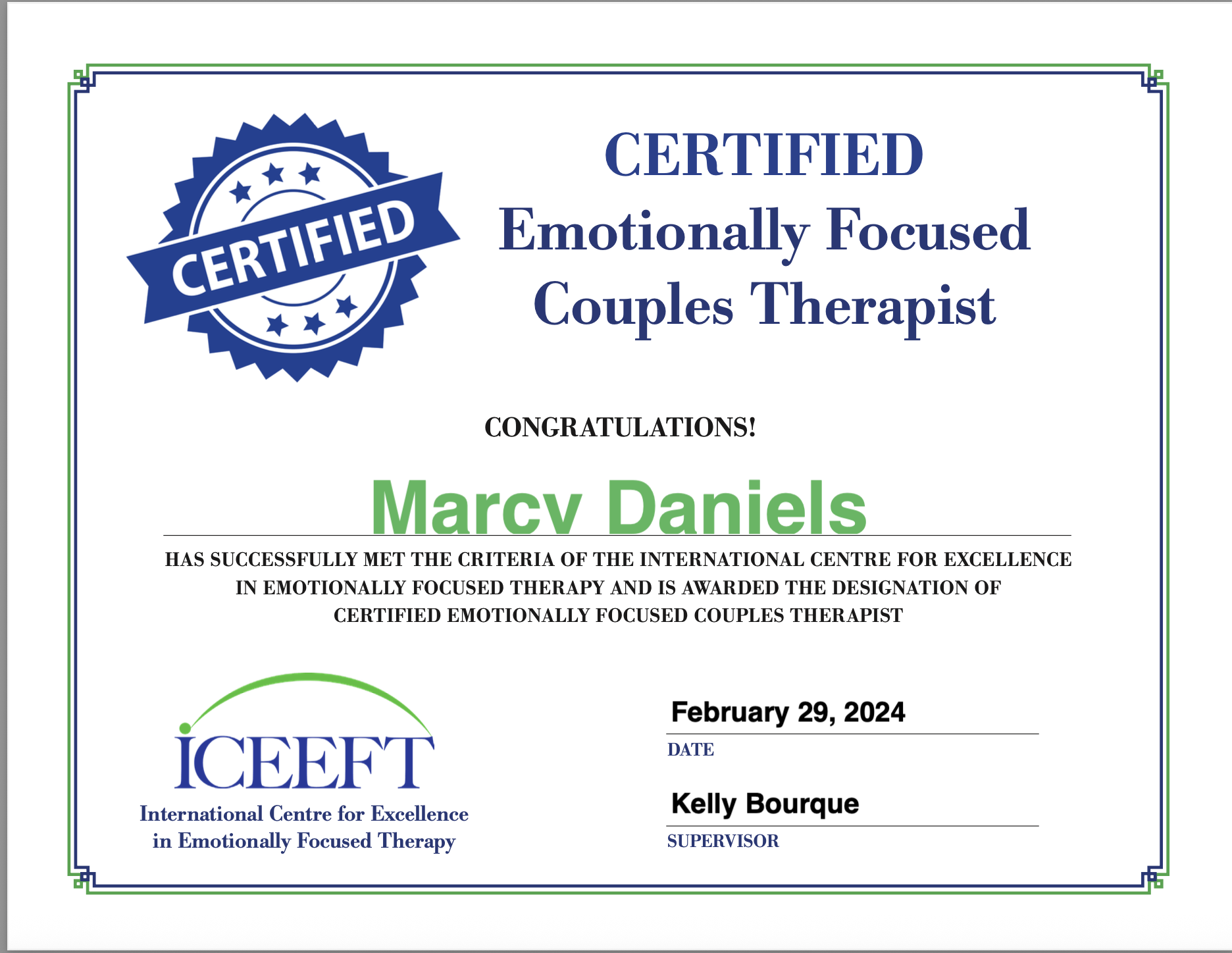
My EFT Journey: More Than a Certificate on the Wall
My journey with Emotionally Focused Couples Therapy began back in 2009 when I attended my first EFT training in Ottawa with Dr. Sue Johnson and the Ottawa Couple and Family Institute (OCFI).
I remember being deeply moved by what I witnessed. It wasn’t just the vulnerability of the couples or the depth of their pain. It was the way Sue was so genuinely present and emotionally attuned to them. Their pain mattered to her, and you could see that in the way she worked with them.
What struck me most was how she could take the very conflicts that were tearing couples apart and help them make sense of those experiences in an entirely different way. Rather than identifying one partner as the problem, she helped couples understand how their reactions to one another were rooted in deeper emotions, attachment needs, and attempts to protect themselves from getting hurt.
There was something incredibly powerful about watching two people who had become so caught up in blaming, defending, or withdrawing begin to see each other differently. Their struggles weren’t being minimized, and neither person was being pathologized. Instead, their experiences were being understood within the context of their relationship.
That experience fundamentally influenced the way I wanted to work with couples.
Over the years, I’ve had the privilege of learning from many exceptional EFT trainers, including Marlene Best, Gail Palmer, and Robert Allan. I’ve also spent countless hours in clinical supervision and consultation with Rebecca Jorgensen, Kelly Bourque, Chad Imhoff, Herman Chow, and Michael Preston, along with many other wonderful EFT colleagues who have challenged my thinking and supported my growth.
Becoming certified wasn’t simply about attending workshops or collecting another set of letters after my name. It meant being willing to have my clinical work examined, receive feedback, recognize where I needed to grow, and keep developing my skills.
And that learning hasn’t stopped with certification. I continue to participate in training and consultation because, even after all these years, there’s always more to learn.
For me, EFT certification represents much more than a professional designation. It reflects a commitment I made many years ago to approach couples with curiosity, compassion, and a deep respect for the emotional experiences that shape their relationships.
That commitment continues to shape how I work with couples today. I don’t see either partner as the problem. Instead, I help couples understand the painful patterns they’ve become caught in, the emotions driving those patterns, and how they can begin finding their way back to each other.
Why This Matters for Couples
If you’re considering couples therapy, you might be wondering whether any of this really matters. After all, isn’t the most important thing finding someone you feel comfortable talking to?
Absolutely. The relationship you have with your therapist matters enormously. But so does their training and ability to help you move beyond talking about the same problems you’ve probably already discussed a hundred times at home.
Many couples come to therapy feeling exhausted, disconnected, and unsure whether anything can actually change. They’ve tried communicating differently, compromising, reading relationship books, or promising themselves they won’t have that argument again. And yet, somehow, they end up right back in the same painful place.
EFT helps us understand why.
Often, the problem isn’t that couples don’t know how to communicate. It’s that their attempts to reach one another have become tangled up in fear, hurt, defensiveness, and disconnection. The more one partner pushes for connection, the more the other may pull away. Or perhaps both partners become increasingly critical and defensive, leaving neither feeling understood.
Working with a Certified EFT Therapist means working with someone who has demonstrated advanced competence in a structured, research-supported approach to understanding and changing these patterns.
Rather than simply teaching you to argue more politely, EFT helps you understand what’s happening underneath those arguments and begin creating new ways of responding to each other.
The goal isn’t to eliminate every disagreement. It’s to help you build a relationship where difficult moments don’t have to threaten your sense of connection and emotional safety.
Does Certification Guarantee Results?
Of course not. And I’d be pretty suspicious of any therapist who promised otherwise!
Relationships are complicated. Every couple brings their own history, experiences, strengths, vulnerabilities, and challenges into therapy. Both partners’ willingness and ability to participate in the process also influence what happens.
Research on EFT has demonstrated encouraging outcomes for couples experiencing relationship distress. However, research findings describe outcomes across groups of couples, not guarantees for any individual relationship.
What certification does tell you is that your therapist has invested significant time and effort in developing their skills, has received specialized supervision and feedback, and has demonstrated competence in applying the EFT model.
It also means there’s a clear therapeutic framework guiding the work, rather than simply hoping that talking about your problems will eventually make things better.
Certification doesn’t mean a therapist knows everything or has all the answers. It means they’ve demonstrated a particular level of training and competence and have committed themselves to practising a well-established model of couples therapy.
A Final Thought
Choosing a couples therapist can feel overwhelming, particularly when your relationship is already struggling. You may be wondering whether therapy will help, whether your partner will feel understood, or whether opening up about painful experiences might somehow make things worse.
Those are understandable concerns.
You deserve to know something about the person you’re trusting with your relationship, including how they’ve been trained, how they approach couples in distress, and what you can expect from the process.
For me, becoming a Certified EFT Therapist has been one part of a much longer professional journey that began in 2009. What first drew me to EFT—the compassion, the emotional attunement, and the belief that even painful relationship patterns can make sense when we understand what’s happening underneath them—continues to guide my work today.
If you’re considering Emotionally Focused Couples Therapy, I’d be happy to talk with you about what the process involves and whether it might be a good fit for your relationship.